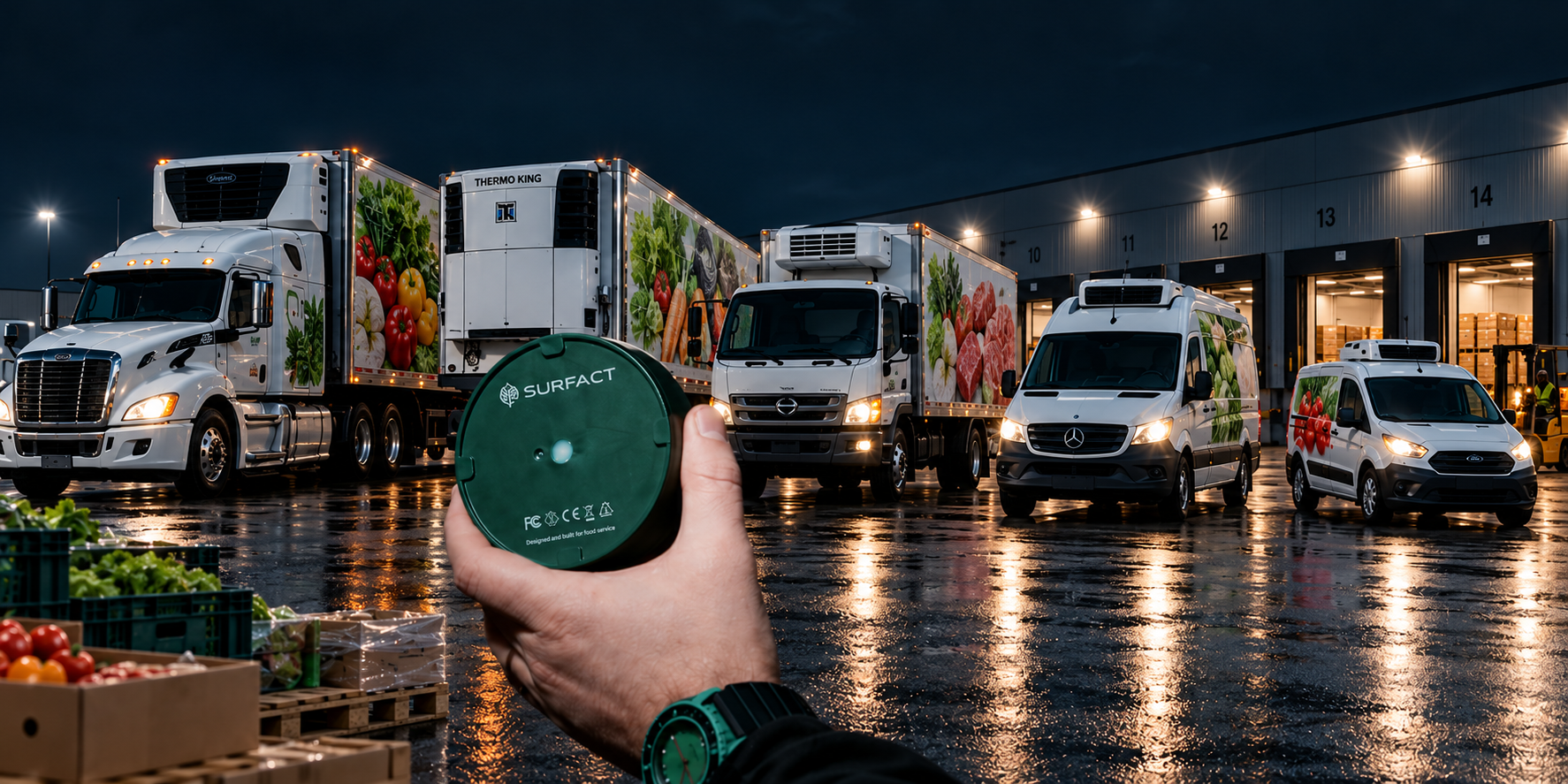
Food retail & restaurant delivery
SQF Edition 10 takes effect January 2, 2027 · See what changes →How do you prove temperature on a load today?
If a customer or the FDA asks, paper logs can't prove it. Emma rides in the reefer or on the pallet and puts every load live in Surfact Signal, including when a third-party haulier is driving.
Supports FSMA · SQF · HACCP · Made in Norway
Emma documents temperature on third-party routes delivering to McDonald's restaurants.

The problem
Food distribution is measured in drops, not in shipments.
A grocery round can be up to forty back doors before lunch in the city, or a few drops spread over hours out in the country, with pallets split, moved and reloaded on the way. The fridge unit reports the box. Nobody reports the goods.
Still checking manually?
Driver checks and handwritten logs leave gaps — procedural, not technical. Temperature visibility shouldn't depend on someone remembering.
Telematics on some vehicles, not all.
And reefer return air tells you about the box, not the pallet by the door that sat warm through a dozen stops.
Third-party fleets are a blind spot.
Most volume moves on hauliers you don't own. If the data belongs to their telematics, you're trusting a promise instead of a record.
Mixed fridge brands, mixed data.
Carrier, Thermo King, Mitsubishi — each with its own portal and export. Nobody gets one picture of the fleet.
How it works
Inside the reefer. Live in seconds.
Peel and place Emma on the inside wall. No hub, no gateway, no wiring into the fridge unit, nothing for the driver to start or stop. Out of coverage, it keeps logging and uploads when the signal returns.
- 01
In the reefer
The default. One Emma per temperature zone, any fridge brand.
- 02
On the pallet
Follows the goods across carriers and cross-docks.
- 03
Inside the load
Between boxes, for the product temperature itself.
Food safety programs
Four programs. One record from dock to dock.
- In force
FSMA Sanitary Transportation
Carrier must show temperature was held, on request, within 24 hours.
- Jan 2, 2027
SQF Edition 10
Loading, transport and staging (12.6.5) becomes a Core Clause. Temperatures recorded at loading and arrival.
- Ongoing
HACCP
Temperature critical control points monitored in transit and storage.
- Jul 20, 2028
FSMA 204 Traceability
Shipping and receiving become Critical Tracking Events.
Loading
Set point and product temperature recorded.
Transit
Continuous record on your data, not the carrier's.
Arrival
Goods-in accepts on data; temperature abuse is visible.
Neither FSMA nor SQF Edition 10 mandates continuous in-transit logging. Both raise the bar for temperature evidence at every handover, and automatic records are the simplest way to meet it. FSMA and SQF apply to operations and facilities, not devices; using Emma does not by itself establish compliance. Sources: 21 CFR 1.908 and 1.912; 21 CFR Part 1, Subpart S; SQF Code Edition 10.
Surfact Signal
Every vehicle. Live. One screen.
Surfact Signal is our temperature control software — live tracking, instant alerts and audit-ready reports.
Prefer your own systems? Stream every reading and alert into your TMS, QA or ERP.
Who it serves
Control over the fleet you don't own.
When the tracker belongs to your goods rather than their vehicle, you see whether the job was done, on every lane, on data you own.
Quality teams
A continuous, time-stamped record per pallet and delivery: the evidence FSMA, SQF and HACCP audits ask for.
Operations
Live temperature and position across the whole round, so a failing fridge is caught at the first drop.
Retailers and buyers
See whether the carrier held temperature on your goods, on your data, independent of their telematics.
Carriers
Documented performance per lane and customer turns arguments about rejected loads into a shared record.
The device
Built in Norway. Calibrated per device.
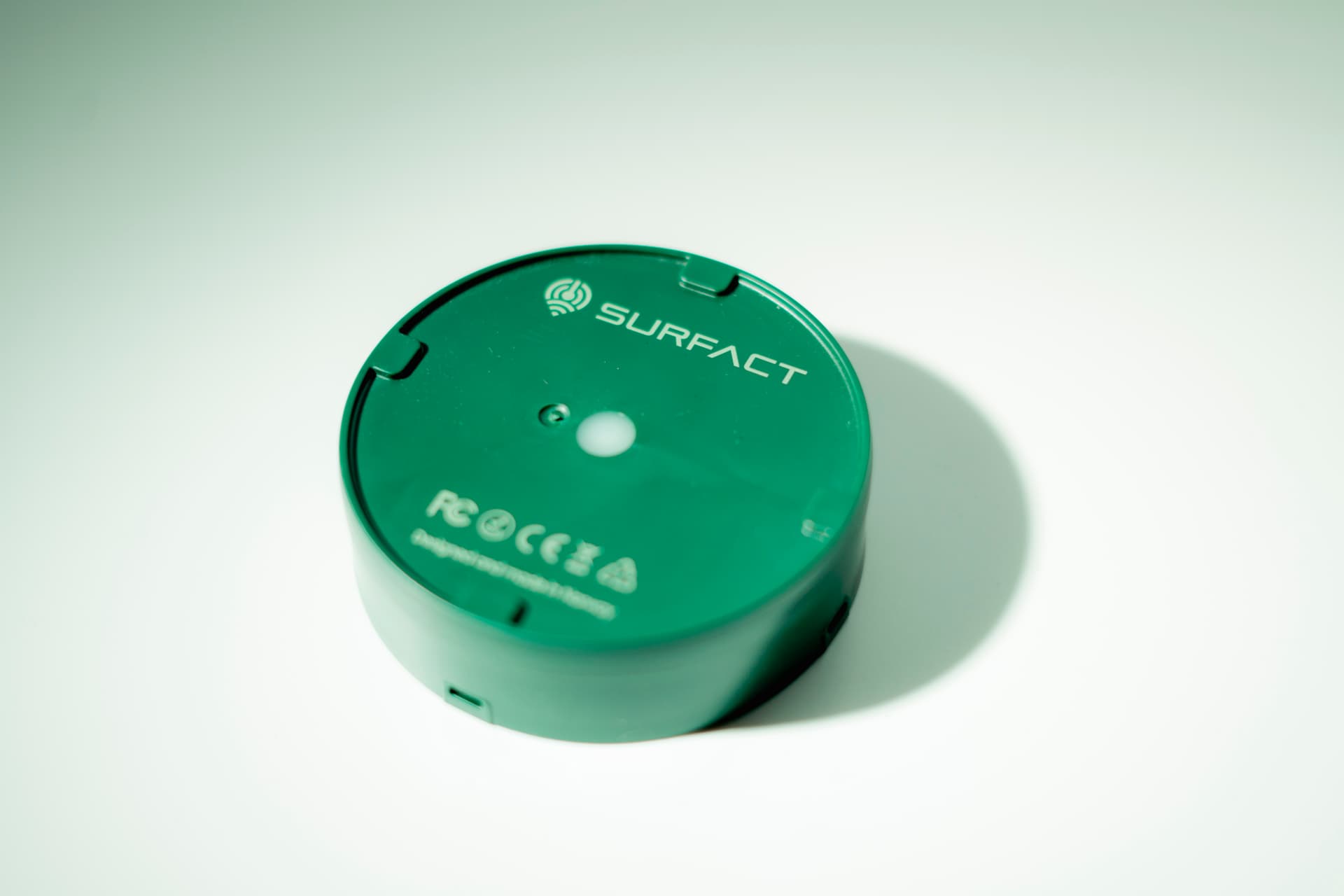
A rugged, self-powered Emma Smart Tracker in recycled ocean plastic, with an ISO 17025 calibration document for every unit: the evidence SQF auditors and customer QA teams ask for.
- Range
- −30 to +60 °C
- Sensor
- Sensirion SHT43
- Connectivity
- 4G / 5G, global
- Drift
- <0.01 °C / yr
- Battery
- 2 years, standard AAs
- Senses
- Temp, humidity, shock, movement, light, location
FAQ
Questions food teams ask.
Does Emma help with FSMA Sanitary Transportation?
Yes. Emma produces continuous, electronic time/temperature records per load that a shipper or carrier can produce on request, well within the 24-hour window.
What changes with SQF Edition 10?
From January 2, 2027, loading, transport and staging (12.6.5) is a Core Clause. Set points and product temperatures must be recorded at loading and on arrival. Emma records both automatically.
Does FSMA require continuous temperature logging?
No, but it requires proof that temperature was maintained when asked. Continuous records are the simplest way to provide it.
Can I monitor loads on third-party carriers?
Yes. Emma rides with the pallet, so the record belongs to the shipper, not the carrier's telematics.
Is Emma calibrated?
Every device has its own calibration document, using ISO 17025-certified Sensirion SHT43 sensors.
Make temperature records part of your food safety program.
From a single pallet to an entire fleet.